jueves, 7 de marzo de 2013


FRENTE AL USURPADOR ¿QUÉ HAREMOS?


Nadie, por muy encumbrado que esté, puede estar por encima de la Constitución y las leyes de la República. En un Estado de derecho, eso no tiene cabida.
Mucho menos alguien que no cuente con la legitimidad democrática que otorga el ser electo de acuerdo con los mecanismos constitucionales establecidos.
En cualquier país del mundo democrático y civilizado, quien llegara a hacerse del poder violentando estos principios, sería calificado de usurpador del poder y repudiado sin contemplaciones, sin perjuicio de su enjuiciamiento posterior. Y ya sabemos que según nuestra Constitución (artículo 138), toda autoridad usurpada es ineficaz y sus actos son nulos. 
En Venezuela, estamos presenciando una evidente usurpación del gobierno, avalada por unas instituciones políticas envilecidas y sumisas a un poder que progresiva y calculadamente ha venido vaciando de contenido toda nuestra democracia y el Estado de Derecho.
Es la forma impune como nuestro particular neoautoritarismo militar está operando, bajo la mirada impasible de muchos en el mundo.
La conducta abyecta y repugnante de los magistrados del Tribunal Supremo de Justicia (TSJ) de Venezuela pasará a la historia igual que la de los juristas del horror nazis. Su mediocridad profesional e inmoralidad sin paralelos será siempre recordada en nuestro país, como la época más oscura del poder judicial.
Gracias a los desaguisados perversos de ese tribunal, somos testigos hoy de cómo el poder hace lo que le viene en gana irrespetando toda norma, pisoteando el Estado de Derecho a voluntad.
Así, tenemos que un candidato ganador de unas elecciones que no cumplió con su  juramento de ley por las razones que ya conocemos y, además, no alcanzó a nombrar a su tren de gobierno, por arte de birlibirloque, es sucedido por un “Presidente encargado”, que no fue electo democráticamente, pero que está ejerciendo con todas las atribuciones constitucionales de uno electo.
¿Cómo puede ocurrir esta aberración? ¿Cómo tal absurda y retorcida interpretación de la Constitución, tal desacatamiento flagrante a la Ley, pueden ser defendidos, sin sentir un mínimo de vergüenza?
La interpretación disparatada y acomodaticia de los que están al frente del TSJ, no puede ser calificada sino de obra de aprendices de brujo, que no de juristas serios comprometidos con la verdad y los principios del Derecho.
Estamos viviendo tiempos de degradación sin precedentes en nuestro país. En la larga historia de dictaduras que ha vivido Venezuela, nunca se llegó a ver un cuerpo de magistrados que llegaran a esos extremos de deshonor y piratería.
Venezuela tiene, en estos momentos, un “Presidente” usurpador, de eso no tengo la menor duda. No sé qué piensan hacer en los días venideros, una vez pase el duelo por el fallecimiento del presidente Chávez.
Lo cierto es que Nicolás Maduro está firmando decretos sin estar constitucionalmente facultado para ello. Maduro no goza de legitimidad democrática alguna.
La Constitución Nacional, como en toda la última década, sigue siendo un instrumento devaluado y decorativo, que es utilizado a su antojo por el poder autoritario militar establecido.
¿Qué harán al respecto las fuerzas democráticas?

Emilio Nouel V.

twitter: @ENouelV


email: emilio.nouel@gmail.com


Chávez death exposes flaws in China’s foreign policy

Ian Bremmer

“[Hugo] Chávez was an outstanding leader of Venezuela, and a good friend of the Chinese people,” noted China’s foreign ministry on Wednesday. Whatever personal sorrow might be felt in Beijing this week, China’s regret at the strongman’s passing is founded largely on worries over the future of economic relations with his government.
Those relations have grown considerably in recent years. According to Matt Ferchen, a scholar at the Carnegie-Tsinghua Center for Global Policy, the China Development Bank has cut loans-for-oil deals in Venezuela over the past five years that account for some 60 per cent of all China’s exposure in Latin America. In 2012, Venezuela made payments on the $42bn loan by sending China an average of about 300,000 barrels of crude oil a day.
There is a broader concern. Chávez’s death caught no one by surprise; it has been expected for many months. But the news from Caracas reminds Chinese officials that their government continues to depend on commercial relations with relatively unpredictable countries that they don’t understand as well as they should.
During a visit to Beijing this week, state officials have told me that they fear the demise of Chávez means the end of his movement — and that the opposition leader Henrique Capriles, once elected president, will undermine China’s considerable interests in the country. Mr Capriles has fed this worry by publicly questioning the legality of the loans-for-oil deal and by arguing that Venezuela should repay the loans in cash rather than oil.
In reality, Chinese concerns about Mr Capriles should remind us how poorly Beijing understands Venezuela. The opposition is unlikely to defeat vice-president Nicolas Maduro, Chávez’s handpicked successor, in the upcoming election and even if Mr Capriles wins, he is highly unlikely to violate the terms of a pre-existing contract. Venezuela’sdire economic circumstances will make it hard for any new president to antagonise deep-pocketed potential friends.
But the larger issue for Beijing has less to do with Venezuela’s fortunes than with the future of China and its foreign policy. In recent years, China’s “go out” foreign investment strategy — a plan designed in part to lock down the long-term supplies of oil, gas, metals, and minerals that China needs to stoke growth, create jobs, and keep the peace—has taken Chinese companies and state officials into some politically unpredictable developing countries. Just in the past two years, a civil war that consumed a friend in Libya, the surprising political opening engineered by allies in Burma, North Korea’s latest nuclear antics and the death of Chávez have reminded China’s leadershipthat their foreign ministry is relatively new to the game of managing political risk. Cutting energy deals in Canada and Brazil are one thing; accepting significant risk exposure in Sudan, Democratic Republic of Congo and Zimbabwe are quite another.
In fact, the single clearest message I have received in Beijing is that while China would always prefer to make deals with predictable partners in predictable countries, China’s leaders know that even after years of efforts to improve political risk assessment, they still must develop a deeper and more refined understanding of all the markets in which China now has commercial interests. That means that this traditionally insular, risk-averse government will become more active on the international stage — not to play a more ambitious global leadership role, but simply to better understand other countries, their political systems and political cultures.
It also means that to protect their own interests, China’s leaders are now more likely to intervene in the political lives of others — and the debate is on in Beijing as to what form “intervention” might take in each case.
In the process of becoming more deeply involved in the politics of foreign countries, they are likely to discover that they have traded one form of risk and uncertainty for another.

The writer is the president of Eurasia Group, a political risk consultancy, and author of ‘Every Nation for Itself: Winners and Losers in a G-Zero World’

(Financial Times)

miércoles, 6 de marzo de 2013


Hugo Chavez’s economic legacy – the two graph version

Today (March 5th) – on the 60 year anniversary of Stalin’s death – Venezuelan president Hugo Chavez passed away.
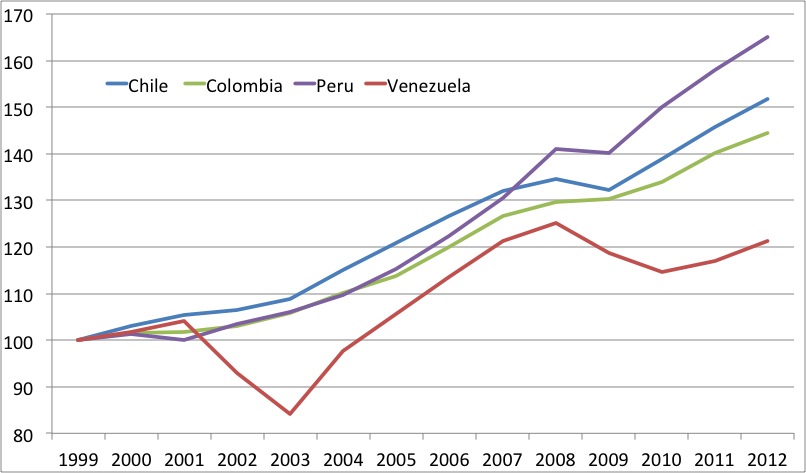
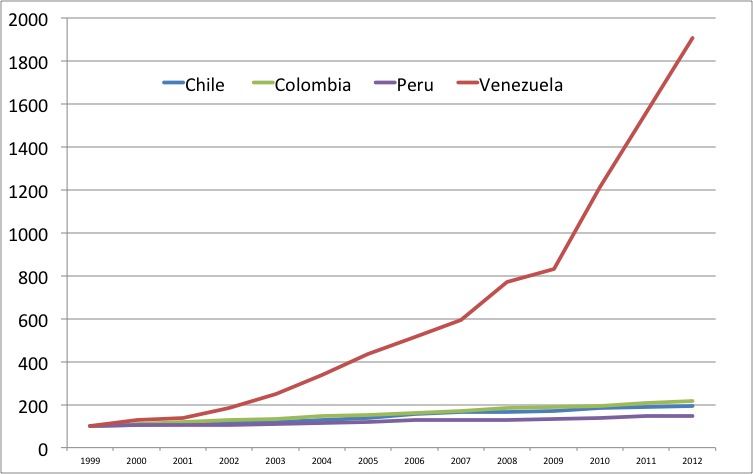
I think Chavez’s economic legacy can be pretty well-illustrated by two graphs comparing Venezuela’s economic performance from 1999 when Chavez became president with three ‘neo-liberal’ Latin American countries – Chile, Peru and Colombia.
We start out with the real GDP level (Index 1999 = 100)
LATAM RGDP
And next the price level (GDP deflator, Index 1999 = 100)
LATAM inflation
I leave it to my readers to judge whether Hugo Chavez’s death is a positive or a negative shock to Venezuela’s economy.
PS I am not claiming that Venezuelan economic statistics has not been manipulated. My source is IMF.

tomado de marketmonetarist.com

martes, 5 de marzo de 2013


LA DEMANDA CONTRA ARGENTINA Y LA DEUDA REESTRUCTURADA


Argentina sigue siendo noticia no sólo por sus reincidentes políticas proteccionistas, sino también porque las demandas milmillonarias que está enfrentando saltan de nuevo a la palestra pública.
En el juicio que siguen contra Argentina los tenedores de bonos que no aceptaron las condiciones y términos de la reestructuración de la deuda (canje) que tuvo lugar en los años 2005 y 2010 en ése país, las cosas se están complicando.
El tribunal de primera instancia de New York, a cargo del juez Thomas Griesa, falló en favor de los demandantes a comienzos del año pasado y ordenó a la  Argentina la constitución de un fondo de garantía de 1.330 millones de dólares en favor de los acreedores.
Los representantes del Estado argentino apelaron y lograron la suspensión del fallo por un tribunal superior, pero  manteniéndose el problema de fondo no resuelto. El fallo de Griesa fue ratificado en Octubre pasado por el Tribunal de Apelaciones, pero éste le pidió al juez que propusiera una fórmula de pago con tratamiento igualitario, tal y como lo piden los demandantes, los cuales habían alegado que este igual tratamiento no había sido dado entre ellos y los que se habían acogido a la reestructuración, esto de conformidad con una cláusula establecida en los contratos de los bonos adquiridos. 
Por otro lado, Griesa dictó una medida que impide los pagos programados a los que sí aceptaron la reestructuración de la deuda, hasta tanto no se abonen los pagos a los demandantes.
Como es conocido, estos últimos han intentado infructuosamente el cobro mediante la ejecución de varias medidas de embargo (por cierto, Cristina Kirchner no viaja en el avión presidencial por temor a que sea embargado en alguno de esos viajes).
Argentina, a pesar de que cuando contrajo la deuda consintió en someterse a la legislación del estado de New York, se niega a pagar a los acreedores demandantes, pues alega que sólo pagará a los que accedieron a la reestructuración, toda vez que pagar a aquellos el 100% de la deuda sería injusto con los últimos.
Por otro lado, se escuda en el principio de soberanía al señalar que no puede subordinarse a un tribunal extranjero. 
No obstante, los abogados de Argentina pidieron una revisión de la decisión del Tribunal de Apelaciones (Octubre 2012), la cual fue rechazada recientemente.
La revisión solicitada se fundamenta en que, según Argentina, la decisión de Griesa quebranta su soberanía, afecta su economía y los procesos futuros de reestructuración de deuda de otros países.
Las resultas del juicio en cuestión tienen efectos no sólo para los argentinos.
Si bien serán graves las repercusiones para Argentina, en caso de que no haya una solución satisfactoria para los demandantes y la sentencia de Griesa se ratifique en la Corte Suprema de EEUU, instancia a la que con seguridad llegará, aquellas trascenderán más allá hacia otros ámbitos.
Ciertamente, los procesos eventuales de reestructuración de deuda en el futuro podrían perder su eficacia integral, toda vez que grupos de acreedores que se nieguen a aceptarlos, colocarían esos procesos en tela de juicio, y nunca mejor dicho.
Si la sentencia de la Corte Suprema de Justicia norteamericana avala lo que ya decidió Griesa (muchos se adelantan a decir que así será), el mundo de las finanzas internacionales recibirá un enorme golpe.
No es que se elimine la posibilidad de reestructuraciones de deuda, siempre habrá quienes se acojan a ellas. El problema será que siempre habrá una espada de Damocles, que podrá ser utilizada en cualquier momento por algún interesado no conforme que conozca del antecedente jurisprudencial y eche mano de él.
En el fondo, y desde el punto de vista jurídico, ningún acreedor está obligado a aceptar las condiciones de pago que proponga su deudor. Puede hacerlo o no.
En la reestructuración de una deuda originada en la adquisición de bonos emitidos por un Estado, intervienen muchos actores: gobiernos, instituciones financieras y acreedores. El elemento político es muy importante en cualquier negociación que se adelante en este ámbito. No hay principio o norma legal que se pueda alegar frente a un acreedor para obligarlo a consentir determinadas estipulaciones en el marco de una reestructuración de deuda pública. Sólo una valoración económica de parte del acreedor es la que definirá su posición frente a la renegociación. De no aceptar la propuesta que hagan los deudores, siempre tendrá la vía contenciosa para obtener la recuperación de su inversión.  
De allí que en el caso de la deuda reestructurada de Argentina y no aceptada por un grupo de acreedores, no parezca haber otra solución que pagar lo adeudado a estos últimos.  A menos que la Corte Suprema de EEUU decida otra cosa. El sector financiero internacional, con seguridad, estará muy atento a esta sentencia, que marcará un hito jurisprudencial  de mucha trascendencia en esta materia. Sin duda, será un precedente a tener en cuenta para futuras emisiones de deudas.

EMILIO NOUEL V.

emilio.nouel@gmail.com

twitter: @EnouelV

lunes, 4 de marzo de 2013

IS MODERN CAPITALISM SUSTAINABLE?


Kenneth Rogoff

CAMBRIDGE – I am often asked if the recent global financial crisis marks the beginning of the end of modern capitalism. It is a curious question, because it seems to presume that there is a viable replacement waiting in the wings. The truth of the matter is that, for now at least, the only serious alternatives to today’s dominant Anglo-American paradigm are other forms of capitalism.


This illustration is by Paul Lachine and comes from <a href="http://www.newsart.com">NewsArt.com</a>, and is the property of the NewsArt organization and of its artist. Reproducing this image is a violation of copyright law.

Continental European capitalism, which combines generous health and social benefits with reasonable working hours, long vacation periods, early retirement, and relatively equal income distributions, would seem to have everything to recommend it – except sustainability. China’s  Darwinian capitalism, with its fierce competition among export firms, a weak social-safety net, and widespread government intervention, is widely touted as the inevitable heir to Western capitalism, if only because of China’s huge size and consistent outsize growth rate. Yet China’s economic system is continually evolving.
Indeed, it is far from clear how far China’s political, economic, and financial structures will continue to transform themselves, and whether China will eventually morph into capitalism’s new exemplar. In any case, China is still encumbered by the usual social, economic, and financial vulnerabilities of a rapidly growing lower-income country.
Perhaps the real point is that, in the broad sweep of history, all current forms of capitalism are ultimately transitional. Modern-day capitalism has had an extraordinary run since the start of the Industrial Revolution two centuries ago, lifting billions of ordinary people out of abject poverty.  Marxism and heavy-handed socialism have disastrous records by comparison. But, as industrialization and technological progress spread to Asia (and now to Africa), someday the struggle for subsistence will no longer be a primary imperative, and contemporary capitalism’s numerous flaws may loom larger.
First, even the leading capitalist economies have failed to price public goods such as clean air and water effectively. The failure of efforts to conclude a new global climate-change agreement is symptomatic of the paralysis.
Second, along with great wealth, capitalism has produced extraordinary levels of inequality. The growing gap is partly a simple byproduct of innovation and entrepreneurship. People do not complain about Steve Jobs’s success; his contributions are obvious. But this is not always the case: great wealth enables groups and individuals to buy political power and influence, which in turn helps to generate even more wealth. Only a few countries – Sweden, for example – have been able to curtail this vicious circle without causing growth to collapse.
A third problem is the provision and distribution of medical care, a market that fails to satisfy several of the basic requirements necessary for the price mechanism to produce economic efficiency, beginning with the difficulty that consumers have in assessing the quality of their treatment.
The problem will only get worse: health-care costs as a proportion of income are sure to rise as societies get richer and older, possibly exceeding 30% of GDP within a few decades. In health care, perhaps more than in any other market, many countries are struggling with the moral dilemma of how to maintain incentives to produce and consume efficiently without producing unacceptably large disparities in access to care.
It is ironic that modern capitalist societies engage in public campaigns to urge individuals to be more attentive to their health, while fostering an economic ecosystem that seduces many consumers into an extremely unhealthy diet. According to the United States Centers for Disease Control, 34% of Americans are obese. Clearly, conventionally measured economic growth – which implies higher consumption – cannot be an end in itself.
Fourth, today’s capitalist systems vastly undervalue the welfare of unborn generations. For most of the era since the Industrial Revolution, this has not mattered, as the continuing boon of technological advance has trumped short-sighted policies. By and large, each generation has found itself significantly better off than the last. But, with the world’s population surging above seven billion, and harbingers of resource constraints becoming ever more apparent, there is no guarantee that this trajectory can be maintained.
Financial crises are of course a fifth problem, perhaps the one that has provoked the most soul-searching of late. In the world of finance, continual technological innovation has not conspicuously reduced risks, and might well have magnified them.
In principle, none of capitalism’s problems is insurmountable, and economists have offered a variety of market-based solutions. A high global price for carbon would induce firms and individuals to internalize the cost of their polluting activities. Tax systems can be designed to provide a greater measure of redistribution of income without necessarily involving crippling distortions, by minimizing non-transparent tax expenditures and keeping marginal rates low.  Effective pricing of health care, including the pricing of waiting times, could encourage a better balance between equality and efficiency. Financial systems could be better regulated, with stricter attention to excessive accumulations of debt.
Will capitalism be a victim of its own success in producing massive wealth? For now, as fashionable as the topic of capitalism’s demise might be, the possibility seems remote. Nevertheless, as pollution, financial instability, health problems, and inequality continue to grow, and as political systems remain paralyzed, capitalism’s future might not seem so secure in a few decades as it seems now.


(tomado de Project Syndicate)

jueves, 28 de febrero de 2013


PERSECUCIÓN POLÍTICA, DEGRADACIÓN MORAL Y DESVERGUENZA INSTITUCIONAL

Tensa es la actual situación política. De nuevo, el poder autoritario arremete contra la oposición democrática, y Venezuela sigue dando qué hablar.
De un país que tiene esbirros por fiscales del ministerio público y  verdugos por jueces, no se puede decir nada bueno. Nuestra administración de justicia es de vómito.
En Venezuela, estamos viviendo momentos álgidos de desvergüenza institucional, de oprobio político. Desde los que usurpan el poder hasta todos los poderes públicos.    
La degradación moral, con una que otra excepción, no puede ser mayor. Ha batido el record histórico nacional. Algo nunca antes visto.
Las más recientes acciones arbitrarias contra dirigentes de la oposición democrática atestiguan hasta dónde son capaces los que gobiernan de pisotear sin ningún pudor todo principio o norma legal.
A Pablo Pérez y Leopoldo López les ha tocado en esta oportunidad ser víctimas del atropello. Éste forma parte del plan de persecución fraguado desde un poder en decadencia, que se pudre en sus entrañas, por la corrupción y el canibalismo interno.
Es muy difícil no sentirse abochornado por la imagen que estamos trasmitiendo al mundo. Si ya ésta era patética en los últimos años, qué se puede decir de lo que está sucediendo en los días que corren.
La burla de que somos objeto todos los venezolanos con la situación opaca de la enfermedad del presidente raya en la obscenidad. Es un escándalo para cualquier observador. Los extranjeros que conocen de nuestros asuntos no pueden comprender, y algunos ni creer, cómo en nuestro país puede estar aconteciendo semejante cosa.
Las violaciones flagrantes y reiteradas a la Constitución, avaladas por un poder judicial infame, que constituirían una afrenta para cualquier pueblo de un país medianamente civilizado, son en el nuestro el pan de cada día.
La barbarie, que ha tomado el poder desde hace más de una década, infringe como le viene en gana, el ordenamiento jurídico. No respeta principios constitucionales, ni normas legales.
La crueldad de quienes gobiernan de cara a los presos políticos que injustamente han sido sentenciados o están en proceso, llega a los niveles de sadismo. La monstruosidad de esta conducta sólo tiene explicación en un grave desequilibrio psicológico o en una enajenación producto de la ideología mortífera que los inspira.
No otra puede ser la conclusión a la que uno puede llegar sobre los salvajes que operan la descomposición social que experimenta lamentablemente Venezuela.
Este horror sin duda, nos sobrecoge. Nunca, ni por asomo, me pasó por la mente que cosa parecida pudiera llegar a ocurrir aquí. El resentimiento y el odio que han sido potenciados y alimentados desde el poder han transformado el alma de muchos venezolanos, para mal, y eso requerirá de mucho esfuerzo para revertirlo.  
Esta atrocidad tiene que parar. Debemos pararla. Política y éticamente estamos obligados a ello. A las fuerzas democráticas les corresponde un delicado papel en la reorientación política, económica y social del país. Y en la coyuntura que se avecina, debe demostrar su capacidad e inteligencia para que el necesario viraje se dé en las condiciones menos traumáticas.
El pulso de los acontecimientos no se puede perder. Las acciones políticas de protesta, denuncia y movilización que sea menester adelantar, deben estar signadas por la estrategia diseñada y consensuada en el seno de la unidad de los partidos democráticos y otras organizaciones. Perseverar en ella es la garantía del triunfo definitivo.     
EMILIO NOUEL V.  

miércoles, 27 de febrero de 2013


OLDIES BUT GOODIES


Sometimes the value of an idea depends on the passage of time.
Take for example the proposal for a U.S. -EU Free Trade Agreement (FTA). The recent White House announcement of the start of negotiations to achieve such an agreement has been widely greeted with approval and support. This was not always the case. Back in 1997 when the Council on Foreign Relations published the first book calling for such a deal, the proposal was widely rejected and sharply criticized by the leading think tanks, commentators, and other purveyors of the conventional wisdom. It was said that such a deal would threaten to destroy the nascent World Trade Organization (WTO), that it wouldn't really produce much in the way of economic benefits because the two economies were already highly integrated, and that it was objectionable because it represented nothing more than the with guys ganging up against the rest.
A lot of water has gone over the dam in the past seventeen years and now, wonder of wonders, the very same people who made these earlier criticisms are now by and large singing the virtues of a potential agreement. Now they are saying that the deal may be necessary in order to save the WTO, that it could kick start economic growth in both the United States and Europe, and that such a deal between the two major western economies would assure the setting of liberal standards before other less open and liberal economies become more dominant.
By the same token, in his New York Times column yesterday, David Brooks said his dream Obama would propose introduction of a value added tax (VAT) that could be used to offset the impact of much of the income tax, rising young family debt, and rising entitlement costs while also enabling reduction of corporate taxes. It all sounded so good coming from David that I wondered why the idea had been rejected when I proposed it back in the 1960s and when numerous other colleagues have proposed it since. I proposed it for a reason that wasn't mentioned by Brooks but should have been. It is that virtually all the other countries in the world have such a tax which is rebated on exports and imposed on imports, thus acting as a kind of indirect tariff on imports and subsidy for exports. For example, let's say that Volkswagen in Germany produces a Passat and exports it to the United States and that the VAT in Germany is 20 percent (its actually about 17 percent, but let's make the math easy). If the car is sold in Germany by VW for $40,000 with the VAT included, it will sell into the United States at $32,000. Meanwhile, if Ford sells an Explorer in the U.S. market for $40,000, its Explorers exported to Germany will be sold at $48,000. The widespread prevalence of this tax combined with America's allergy to it, is a major contributor to the chronic U.S. trade deficit, loss of jobs, and loss of U.S. tax revenue.
Brooks seems to think Republicans would back this kind of a tax. All I can say is that in my experience in the Reagan administration and from my observations of the two Bush administrations, Republican economists think of a VAT as anathema, as protectionist, and as something Americans shouldn't do. Maybe Brooks can convince them they're wrong, not least because they are. But it's also a good idea even if it is an old one.
Tonight's final example comes from a just released MIT study labeled Production in the Innovation Economy (PIE). Essentially the study by an eminent panel of economists, engineers, and political scientists concludes that more domestic production of a wider variety of items maximizes innovation and reduces the overall cost of production. That the loss of spillovers and externalities constitutes a high but difficult to quantify cost of the off-shoring of production has long been suspected by a few industry analysts such as Harvard's Willy Shi and Gary Pisano and IBM's former chief scientist Ralph Gomory. But any hesitation about breaking up the supply chain and moving parts of it offshore, has always been strongly attacked by economists as costly protectionism contrary to free trade. Now, after  decades of argumentation, the distinguished MIT panel has concluded that the old arguments weren't so dumb after all.
All this brings to my mind the wisdom of the old Swahili aphorism that: "Before a man does away with the old Gods, he must first make sure he has something of value with which to replace them." 

lunes, 25 de febrero de 2013


How Mexico Got Back in the Game


     Thomas Friedman


IN India, people ask you about China, and, in China, people ask you about India: Which country will become the more dominant economic power in the 21st century? I now have the answer: Mexico.
Impossible, you say? Well, yes, Mexico with only about 110 million people could never rival China or India in total economic clout. But here’s what I’ve learned from this visit to Mexico’s industrial/innovation center in Monterrey. Everything you’ve read about Mexico is true: drug cartels, crime syndicates, government corruption and weak rule of law hobble the nation. But that’s half the story. The reality is that Mexico today is more like a crazy blend of the movies “No Country for Old Men” and “The Social Network.”
Something happened here. It’s as if Mexicans subconsciously decided that their drug-related violence is a condition to be lived with and combated but not something to define them any longer. Mexico has signed 44 free trade agreements — more than any country in the world — which, according to The Financial Times, is more than twice as many as China and four times more than Brazil. Mexico has also greatly increased the number of engineers and skilled laborers graduating from its schools. Put all that together with massive cheap natural gas finds, and rising wage and transportation costs in China, and it is no surprise that Mexico now is taking manufacturing market share back from Asia and attracting more global investment than ever in autos, aerospace and household goods.
“Today, Mexico exports more manufactured products than the rest of Latin America put together,” The Financial Times reported on Sept. 19, 2012. “Chrysler, for example, is usingMexico as a base to supply some of its Fiat 500s to the Chinese market.” What struck me most here in Monterrey, though, is the number of tech start-ups that are emerging from Mexico’s young population — 50 percent of the country is under 29 — thanks to cheap, open source innovation tools and cloud computing.
“Mexico did not waste its crisis,” remarked Patrick Kane Zambrano, director of the Center for Citizen Integration, referring to the fact that when Mexican companies lost out to China in the 1990s, they had no choice but to get more productive. Zambrano’s Web site embodies the youthful zest here for using technology to both innovate and stimulate social activism. The center aggregates Twitter messages from citizens about everything from broken streetlights to “situations of risk” and plots them in real-time on a phone app map of Monterrey that warns residents what streets to avoid, alerts the police to shootings and counts in days or hours how quickly public officials fix the problems.
“It sets pressure points to force change,” the center’s president, Bernardo Bichara, told me. “Once a citizen feels he is not powerless, he can aspire for more change. ... First, the Web democratized commerce, and then it democratized media, and now it is democratizing democracy.”
If Secretary of State John Kerry is looking for a new agenda, he might want to focus on forging closer integration with Mexico rather than beating his head against the rocks of Israel, Palestine, Afghanistan or Syria. Better integration of Mexico’s manufacturing and innovation prowess into America’s is a win-win. It makes U.S. companies more profitable and competitive, so they can expand at home and abroad, and it gives Mexicans a reason to stay home and reduces violence. We do $1.5 billion a day in trade with Mexico, and have been spending $300 million a day in Afghanistan. Not smart.
We need a more nuanced view of Mexico. While touring the Center for Agrobiotechnology at Monterrey Tech, Mexico’s M.I.T., its director, Guy Cardineau, an American scientist from Arizona, remarked to me that, in 2011, “my son-in-law returned from a tour of duty in Afghanistan and we talked about having him come down and visit for Christmas. But he told me the U.S. military said he couldn’t come because of the [State Department] travel advisory here. I thought that was very ironic.”
Especially when U.S. companies are expanding here, which is one reason Mexico grew last year at 3.9 percent, and foreign direct investment in Monterrey hit record highs.
“Twenty years ago, most Mexican companies were not global,” explained Blanca Treviño, the president and founder of Softtek, one of Mexico’s leading I.T. service providers. They focused on the domestic market and cheap labor for the U.S. “Today, we understand that we have to compete globally” and that means “becoming efficient. We have a [software] development center in Wuxi, China. But we are more efficient now in doing the same business from our center in Aguascalientes, [Mexico], than we are from our center in Wuxi.”
Mexico still has huge governance problems to fix, but what’s interesting is that, after 15 years of political paralysis, Mexico’s three major political parties have just signed “a grand bargain,” a k a “Pact for Mexico,” under the new president, Enrique Peña Nieto, to work together to fight the big energy, telecom and teacher monopolies that have held Mexico back. If they succeed, maybe Mexico will teach us something about democracy. Mexicans have started to wonder about America lately, said Bichara from the Center for Citizen Integration. “We always thought we should have our parties behave like the United States’ — no longer. We always thought we should have the government work like the United States’ — no longer.”
This article has been revised to reflect the following correction:
Correction: February 24, 2013
An earlier version of this column misstated the amount the United States has been spending in Afghanistan. It is $300 million a day, not $1 billion a day.